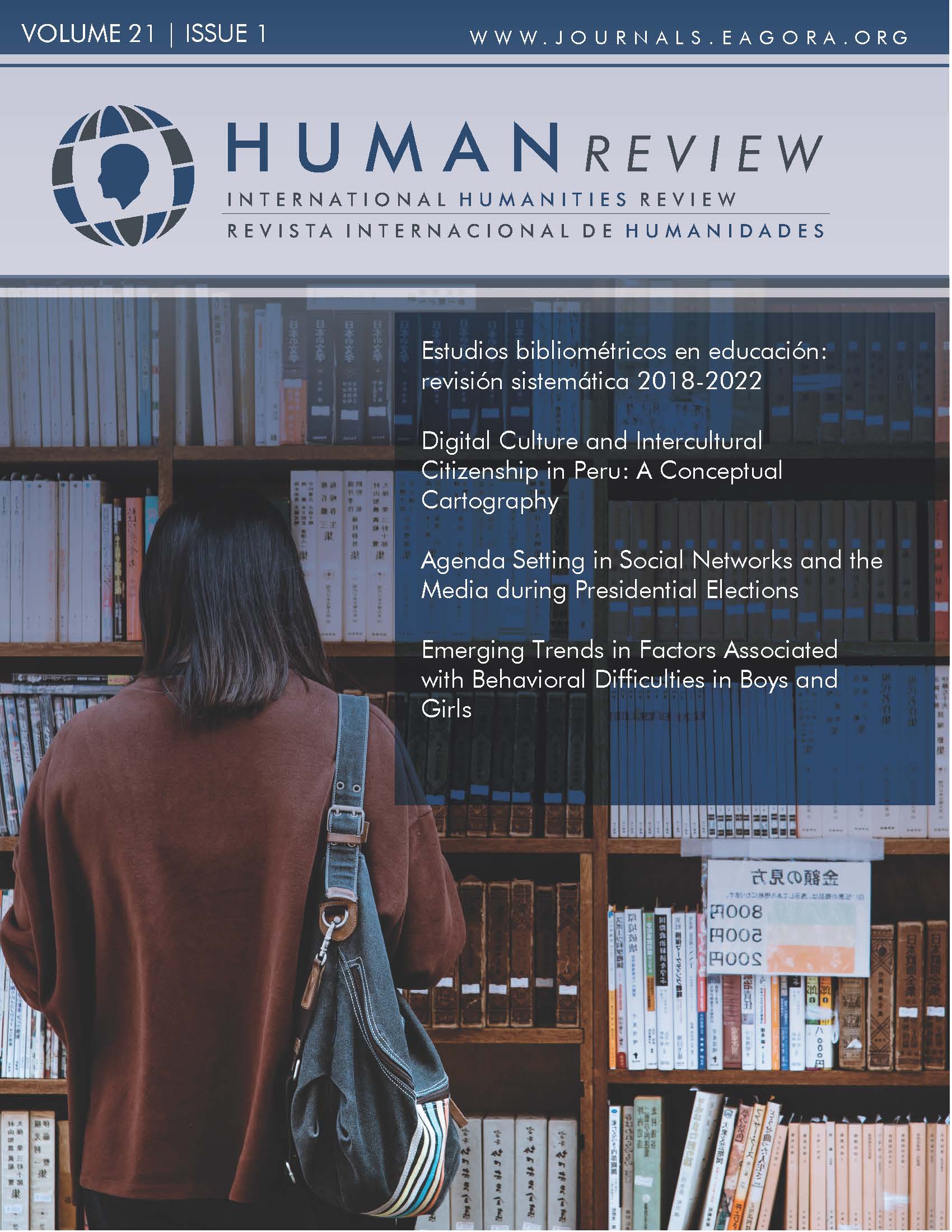
Agenda Setting in Social Networks and the Media during Presidential Elections
Palabras clave:
Agenda setting, Social media, Mass media, Presidential electoral processesResumen
This article examines the role of social media and journalistic media in presidential electoral processes. A systematic review of scientific articles published from 2012 to 2022 was conducted. The results indicate that the media has a significant influence on public perception and the political agenda during election campaigns. Furthermore, the importance of evaluating political leaders in the voters' decision-making process is emphasized. In summary, the article provides valuable insights into how the media can shape the narrative and public opinion during presidential elections.
Descargas
Citas
Allcott, H., & Gentzkow, M. (2017). Social media and fake news in the 2016 election. The Journal of Economic Perspectives, 31(2), 211-236. doi:10.1257/jep.31.2.211. DOI: https://doi.org/10.1257/jep.31.2.211
Althaus, S. L., & Tewksbury, D. (2002). Agenda setting and the "new" news patterns of issue importance among readers of the paper and online versions of the New York Times. Communication Research, 29(2), 180-207. doi:10.1177/0093650202029002004. DOI: https://doi.org/10.1177/0093650202029002004
An, J., Cha, M., Gummadi, K., & Crowcroft, J. (2011). Media landscape in Twitter: A world of new conventions and political diversity. In Proceedings of the Fifth International AAAI Conference on Weblogs and Social Media (pp. 18-25). Menlo Park, CA: The AAAI Press. Retrieved from shorturl.at/chsKR DOI: https://doi.org/10.1609/icwsm.v5i1.14118
Ansolabehere, S., & Iyengar, S. (1994). Riding the wave and claiming ownership over issues: The joint effects of advertising and news coverage in campaigns. Public Opinion Quarterly, 58(3), 335-357. DOI: https://doi.org/10.1086/269431
Aruguete, N. (2017). The Agenda Setting Hypothesis in the New Media Environment. Communication and Society, 28, 35-58. doi:10.32870/cys.v0i28.2929. DOI: https://doi.org/10.32870/cys.v0i28.2929
Asp, K. (1983). The Struggle for the Agenda. Communication Research, 10, 333-355. DOI: https://doi.org/10.1177/009365083010003004
Atwater, T., Fico, F., & Pizante, G. (1987). Reporting on the State Legislature: A Case Study of Inter-media Agenda-Setting. Newspaper Research Journal, 8(2), 53-61. DOI: https://doi.org/10.1177/073953298700800206
Bakir, V., & McStay, A. (2018). Fake news and the economy of emotions: Problems, causes, solutions. Digital Journalism, 6, 154-175. doi:10.1080/21670811.2017.1345645. DOI: https://doi.org/10.1080/21670811.2017.1345645
Bakshy, E., Rosenn, I., Marlow, C., & Adamic, L. (2012, April). The role of social networks in information diffusion. Proceedings of the 21st International Conference on World Wide Web (pp. 519-528). doi:10.1145/2187836.2187907. DOI: https://doi.org/10.1145/2187836.2187907
Banducci, S., Cioroianu, I., Coan, T., Katz, G., & Stevens, D. (2018). Intermedia agenda setting in personalized campaigns: How news media influence the importance of leaders. Electoral Studies, 54, 281-288. doi:10.1016/j.electstud.2018.04.011 DOI: https://doi.org/10.1016/j.electstud.2018.04.011
Beckers, K., & Harder, R. A. (2016). Twitter just exploded. Digital Journalism, 4, 910-920. doi:10.1080/21670811.2016.1161493. DOI: https://doi.org/10.1080/21670811.2016.1161493
Bélanger, É., & Meguid, B. (2008). Issue salience, issue ownership, and issue-based vote choice. Electoral Studies, 27, 477-491. DOI: https://doi.org/10.1016/j.electstud.2008.01.001
Blasco-Duatis, M., Coenders Gallart, G., & Sáez, M. (2018). Compositional representation of the intermediate agenda-setting of the main media groups and political parties in the 2015 Spanish general elections. Revista Latina De Comunicacion Social, (73), 264-292. doi:10.4185/RLCS-2018-1255. DOI: https://doi.org/10.4185/RLCS-2018-1255
Blumler, J. G. (1979). The role of theory in uses and gratifications studies. Communication Research, 6(1), 9-36. DOI: https://doi.org/10.1177/009365027900600102
Blumler, J., & Kavanagh, D. (1999). The Third Age of Political Communication: Influences and Features. Political Communication, 16(3), 209-230. DOI: https://doi.org/10.1080/105846099198596
Boyle, T. P. (2001). Intermedia agenda setting in the 1996 presidential election. Journalism and Mass Communication Quarterly, 78, 26-44. DOI: https://doi.org/10.1177/107769900107800103
Breed, W. (1955). Newspaper 'Opinion Leaders' and Processes of Standardization. Journalism Quarterly, 32, 277-284. DOI: https://doi.org/10.1177/107769905503200302
Broersma, M., & Graham, T. (2012). Social media as beat: Tweets as a news source during the 2010 British and Dutch elections. Journalism Practice, 6(3), 403-419. doi:10.1080/17512786.2012.663626. DOI: https://doi.org/10.1080/17512786.2012.663626
Bruns, A., & Highfield, T. (2012). Blogs, Twitter, and Breaking News: The Produsage of Citizen Journalism. In R. A. Lind (Ed.), Produsing Theory in a Digital World: The Intersection of Audiences and Production (pp. 15-32). Peter Lang.
Brustein, J. (2010, October 31). Nation's political pulse, taken using net chatter. The New York Times. http://www.nytimes.com/2010/11/01/technology/01sentiment.html?mabReward=relbias:ry_r=0yadxnnl=1ymodule=Searchyadxnnlx=1403302223qaXVmgJsQ064f7h54jA2BQ
Budge, I., & Farlie, D. (1983). Explaining and predicting elections: Issue effects and party strategies in twenty-three democracies. George Allen & Unwin.
Camaj, L., & Weaver, D. H. (2013). Need for Orientation and Attribute Agenda-Setting During a U.S. Election Campaign. International Journal of Communication, 7, 1442-1463.
Chadwick, A. (2013). The Hybrid Media System: Politics and Power. Oxford Studies in Digital Politics. Oxford University Press. DOI: https://doi.org/10.1093/acprof:oso/9780199759477.001.0001
Coleman, R., & Wu, H. D. (2022). Individual differences in affective agenda setting: A cross-sectional analysis of three U.S. presidential elections. Journalism, 23(5), 992-1009. doi:10.1177/1464884921990242. DOI: https://doi.org/10.1177/1464884921990242
Conway, B. A., Kenski, K., & Wang, D. (2015). The rise of Twitter in the political campaign: Searching for intermedia agenda-setting effects in the presidential primary. Journal of Computer-Mediated Communication, 20(4), 363-380. doi:10.1111/jcc4.12124. DOI: https://doi.org/10.1111/jcc4.12124
Cushion, S., Kilby, A., Thomas, R., Morani, M., & Sambrook, R. (2016). Newspapers, Impartiality and Television News: Intermedia agenda-setting during the 2015 UK General Election campaign. Journalism Studies, 1-20. http://dx.doi.org/10.1080/1461670X.2016.1171163 DOI: https://doi.org/10.1080/1461670X.2016.1171163
Dearing, J., & Rogers, E. (1996). Communication Concepts 6: Agenda Setting. Thousand Oaks, CA: Sage. DOI: https://doi.org/10.4135/9781452243283
Denham, B. E. (2010). Toward conceptual consistency in studies of agenda-building processes: A scholarly review. The Review of Communication, 10, 306-323. doi: 10.1080/15358593.2010.502593. DOI: https://doi.org/10.1080/15358593.2010.502593
Denham, B. E. (2014). Intermedia attribute agenda setting in the New York Times: The case of animal abuse in US horse racing. Journalism and Mass Communication Quarterly, 91, 17-37. doi:10.1177/1077699013514415. DOI: https://doi.org/10.1177/1077699013514415
Drezner, D., & Farrell, H. (2004). The power and politics of blogs. Paper presented at the meeting of the American Political Science Association, Chicago, IL.
Garza-Alanis, E. C. (2013). Analyzing the presidential election of 2012 from the perspective of agenda setting in Monterrey press. Estudios Sobre El Mensaje Periodistico, 19(SPEC. APR), 793-801. doi:10.5209/rev_ESMP.2013.v19.42162. DOI: https://doi.org/10.5209/rev_ESMP.2013.v19.42162
Gilardi, F., Gessler, T., Kubli, M., & Müller, S. (2022). Issue ownership and agenda setting in the 2019 Swiss national elections. Swiss Political Science Review, 28(2), 190-208. doi:10.1111/spsr.12496. DOI: https://doi.org/10.1111/spsr.12496
Gonzenbach, W., & McGavin, L. (1997). A brief story of time: A methodological analysis of agenda setting. In M. McCombs, D. Shaw, & D. Weaver (Eds.), Communication and Democracy: Exploring the Intellectual Frontiers in Agenda-Setting Theory (pp. 115-136). Lawrence Erlbaum Associates.
Griffin, E. (2012). A First Look at Communication Theory. McGraw-Hill.
Groshek, J., & Groshek, M. C. (2013). Agenda trending: Reciprocity and the predictive capacity of social networking sites in intermedia agenda setting across topics over time. Media and Communication, 1(1), 15-27. doi:10.17645/mac.v1i1.71. DOI: https://doi.org/10.17645/mac.v1i1.71
Guo, L. (2012). The application of social network analysis in agenda setting research: A methodological exploration. Journal of Broadcasting and Electronic Media, 56, 616-631. doi:10.1080/08838151.2012.732148. DOI: https://doi.org/10.1080/08838151.2012.732148
Guo, L., & Vargo, C. (2015). The power of message networks: A big-data analysis of the network agenda-setting model and issue ownership. Mass Communication and Society, 18, 557-576. doi:10.1080/15205436.2015.1045300. DOI: https://doi.org/10.1080/15205436.2015.1045300
Guo, L., & Vargo, C. (2020). "Fake news" and emerging online media ecosystem: An integrated intermedia agenda-setting analysis of the 2016 U.S. presidential election. Communication Research, 47(2), 178-200. doi:10.1177/0093650218777177 DOI: https://doi.org/10.1177/0093650218777177
Harder, R. A., Sevenans, J., & Van Aelst, P. (2017). Intermedia agenda setting in the social media age: How traditional players dominate the news agenda in election times. International Journal of Press/Politics, 22(3), 275-293. doi:10.1177/1940161217704969. DOI: https://doi.org/10.1177/1940161217704969
Heim, K. (2013). Framing the 2008 Iowa Democratic caucuses: Political blogs and second-level intermedia agenda setting. Journalism and Mass Communication Quarterly, 90(3), 500-519. doi:10.1177/1077699013493785 DOI: https://doi.org/10.1177/1077699013493785
Hermida, A. (2010). Twittering the news: The emergence of ambient journalism. Journalism practice, 4(3), 297-308. http://dx.doi.org/10.1080/17512781003640703 DOI: https://doi.org/10.1080/17512781003640703
Holian, D. B. (2004). He's stealing my issues! Clinton's crime rhetoric and the dynamics of issue ownership. Political Behavior, 26(2), 95-124. DOI: https://doi.org/10.1023/B:POBE.0000035959.35567.16
Hopmann, D. N., Elmelund-Præstekær, C., Albæk, E., Vliegenthart, R., & de Vreese, C. H. (2012). Party media agenda-setting: How parties influence election news coverage. Party Politics, 18(2), 173-191. doi:10.1177/1354068810380097. DOI: https://doi.org/10.1177/1354068810380097
Igartua, J. J., & Humanes, M. L. (Eds.) (2004). Teoría e investigación en comunicación social. Síntesis.
Iyengar, S., Hahn, K., Krosnick, J., & Walker, J. (2008). Selective exposure to campaign communication: The role of anticipated agreement and issue public membership. Journal of Politics, 70(1), 186-200. DOI: https://doi.org/10.1017/S0022381607080139
Jacobsen, A. (2013). Lights, Camera, Vote: An Agenda-Setting Analysis of Celebrity Endorsements and News Correlation during the 2012 Presidential Election [Master thesis, Liberty University]. Digital archive. https://digitalcommons.liberty.edu/masters/293/
oa, Y. (2017). A Hyperlink and Sentiment Analysis of the 2016 Presidential Election: Intermedia Issue Agenda and Attribute Agenda Setting in Online Contexts [Doctoral thesis, Bowling Green State University]. Digital archive. https://scholarworks.bgsu.edu/media_comm_diss/46/
Johnson, T., & Perlmutter, D. (2010). Introduction: The Facebook Election. Mass Communication and Society, 13, 554-559. DOI: https://doi.org/10.1080/15205436.2010.517490
Kaus, M. (1986). Age of Celebritics. New Republic.
Kee, C. P., Salman, A., Ni, K. S., Yaakop, M. R. M., Adisa, R. M., & Hoong, O. C. (2017). The agenda setting function of English newspapers during the 13th general election. Jurnal Komunikasi: Malaysian Journal of Communication, 33(2), 27-39. doi:10.17576/jkmjc-2017-3302-03. DOI: https://doi.org/10.17576/JKMJC-2017-3302-03
Kim, J. (2018). One name can change many things: Influences of mentioning political candidates on network agenda-setting effects in the 2016 U.S. election. Agenda Setting Journal: Theory, Practice, Critique, 2(1), 41-63. doi:10.1075/asj.17009.kim. DOI: https://doi.org/10.1075/asj.17009.kim
Kim, K., & McCombs, M. (2007). News story descriptions and the public's opinions of political candidates. Journalism and Mass Communication Quarterly, 84(2), 299-314. DOI: https://doi.org/10.1177/107769900708400207
Kim, Y., Gonzenbach, W. J., Vargo, C. J., & Kim, Y. (2016). First and second levels of intermedia agenda setting: Political advertising, newspapers, and Twitter during the 2012 U.S. presidential election. International Journal of Communication, 10, 4550-4569.
Kiousis, S., & McCombs, M. (2004). Agenda-setting effects and attitude strength: Political figures during the 1996 presidential election. Communication Research, 31, 36-57. DOI: https://doi.org/10.1177/0093650203260205
Kiousis, S., Bantimaroudis, P., & Ban, H. (1999). Candidate image attributes: Experiments on the substantive dimension of second level agenda setting. Communication Research, 26(4), 414-428. DOI: https://doi.org/10.1177/009365099026004003
Kiousis, S., Strömback, J., & Mcdevitt, M. (2015). Influence of issue decision salience on vote choice: Linking agenda setting, priming, and issue ownership. International Journal of Communication, 9(1), 3347-3368.
Lee, B., Lancendorfer, K. M., & Lee, K. J. (2005). Agenda-setting and the Internet: The intermedia influence of Internet bulletin boards on newspaper coverage of the 2000 general election in South Korea. Asian Journal of Communication, 15(1), 57-71. DOI: https://doi.org/10.1080/0129298042000329793
Lewis, S. C. (2010). Citizen journalism: Motivations, methods, and momentum. In M. E. McCombs, A. W. Hinsley, K. Kaufhold, & S. C. Lewis (Eds.), The future of news: An agenda of perspectives (pp. 59-76). Cognella.
Liberati, A., Altman, D., Tetzlaff, J., Mulrow, C., Gøtzsche, P., Ioannidis, J., Clarke, M., Devereaux, P., Kleijnen, J., & Moher, D. (2009). The PRISMA statement for reporting systematic reviews and meta-analyses of studies that evaluate health care interventions: Explanation and elaboration. Journal of Clinical Epidemiology, 62(10), e1-e34. DOI: https://doi.org/10.1016/j.jclinepi.2009.06.006
Marcus, G. E., Neuman, W. R., & MacKuen, M. (2000). Affective Intelligence and Political Judgment. University of Chicago Press.
Marsh, D., 't Hart, P., & Tindall, K. (2010). Celebrity Politics: The Politics Of The Late Modernity. Political Studies Review, 8(3), 322-340. DOI: https://doi.org/10.1111/j.1478-9302.2010.00215.x
Mayer, J. D., & Cornfield, M. (2008). The internet and the future of media politics. In M. J. Rozell & J. D. Meyer (Eds.), Media power, media politics (pp. 319-337). Rowman & Littlefield.
McAllister, I. (2007). The personalization of politics. In R. J. Dalton & H. D. Klingemann (Eds.), The Oxford Handbook of Political Behavior (pp. 571-588). Oxford University Press. DOI: https://doi.org/10.1093/oxfordhb/9780199270125.003.0030
McCombs, M. (2004). Setting the agenda: The mass media and public opinion. Polity Press.
McCombs, M. (2013). The Agenda-Setting Role of Mass Media in the Shaping of Public Opinion. Info America. DOI: https://doi.org/10.1002/9781118591178.ch14
McCombs, M. (2014). Setting the agenda: The mass media and public opinion. Polity Press.
McCombs, M. E. (2005). A look at agenda-setting: Past, present, and future. Journalism Studies, 6(4), 543-557. DOI: https://doi.org/10.1080/14616700500250438
McCombs, M., & Ghanem, S. (2001). The convergence of agenda setting and framing. In S. D. Reese, O. H. Gandy, Jr., & A. E. Grant (Eds.), Framing Public Life: Perspectives on Media and Our Understanding of the Social World (pp. 67-83). Mahwah, NJ: Erlbaum. DOI: https://doi.org/10.4324/9781410605689-10
McCombs, M., & Weaver, D. H. (1973). Voters' need for orientation and use of mass communication. Paper presented at the annual conference of the International Communication Association, Montreal, Canada, April.
McCombs, M., Llamas, J. P., Lopez-Escobar, E., & Rey, F. (1997). Candidate images in Spanish elections: Second-level agenda-setting effects. Journalism & Mass Communication Quarterly, 74(4), 703-717. DOI: https://doi.org/10.1177/107769909707400404
McCombs, M., Lopez-Escobar, E., & Llamas, J. P. (2000). Setting the agenda of attributes in the 1996 Spanish general election. Journal of Communication, 50(2), 77-92. DOI: https://doi.org/10.1111/j.1460-2466.2000.tb02842.x
McGregor, S. C., & Vargo, C. J. (2017). Election-related talk and agenda-setting effects on Twitter: A big data analysis of salience transfer at different levels of user participation. Agenda Setting Journal, 1(1), 44-62. doi:10.1075/asj.1.1.05mcg. DOI: https://doi.org/10.1075/asj.1.1.05mcg
Miller, J. (2007). Examining the mediators of agenda setting: A new experimental paradigm reveals the role of emotions. Political Psychology, 28, 689-717. DOI: https://doi.org/10.1111/j.1467-9221.2007.00600.x
Nossek, H., & Adoni, H. (2011). On Gutenberg's Shoulders. Panim, 54, 35-50.
Papacharissi, Z., & de Fatima Oliveira, M. (2012). Affective news and networked publics: The rhythms of news storytelling on #Egypt. Journal of Communication, 62(2), 266-282. doi:10.1111/j.1460-2466.2012.01630.x. DOI: https://doi.org/10.1111/j.1460-2466.2012.01630.x
Parmelee, J. H. (2014). The agenda-building function of political tweets. New Media & Society, 16(3), 434-450. doi:10.1177/146144444813487955. DOI: https://doi.org/10.1177/1461444813487955
Patterson, T., & Donsbach, W. (1998). News Decisions: Journalists as Partisan Actors. Political Communication, 13(4), 455-468. DOI: https://doi.org/10.1080/10584609.1996.9963131
Pedro-Carañana, J., Alvarado-Vivas, S., & López-López, J. S. (2020). Agenda-setting and power relations during the 2018 Colombian election campaign on Twitter. Journal of International Communication, 26(2), 260-280. doi:10.1080/13216597.2020.1806900. DOI: https://doi.org/10.1080/13216597.2020.1806900
Rubin, A. M. (2009). Uses-and-gratifications perspective on media effects. In J. Bryant & M. B. Oliver (Eds.), Media effects: Advances in theory and research (pp. 165-184). Routledge.
Shaw, D., & Roberts, B. (2000). Campaign events, the media and the prospects of victory: The 1992 and 1996 US presidential elections. British Journal of Political Science, 30(2), 259-289. DOI: https://doi.org/10.1017/S0007123400000120
Shoemaker, P. J., & Reese, S. D. (1996). Mediating the message: Theories of influences on mass media content. Longman.
Strömer-Galley, J. (2014). Presidential campaigning in the Internet age. Oxford University Press. DOI: https://doi.org/10.1093/acprof:oso/9780199731930.001.0001
Sweetser, K. D., Golan, G. J., & Wanta, W. (2008). Intermedia agenda setting in television, advertising, and blogs during the 2004 election. Mass Communication & Society, 11(2), 197-216. doi:10.1080/1520543030701590267 DOI: https://doi.org/10.1080/15205430701590267
Takeshita, T. (1993). Agenda-setting effects of the press in a Japanese local election. Studies of Broadcasting, 29, 193-216.
Tandoc, E. C., Jr, Lim, Z. W., & Ling, R. (2018). Defining "Fake News": A typology of scholarly definitions. Digital Journalism, 6, 137-153. doi:10.1080/21670811.2017.1360143. DOI: https://doi.org/10.1080/21670811.2017.1360143
Towner, T., & Muñoz, C. L. (2020). Instagramming issues: Agenda setting during the 2016 presidential campaign. Social Media and Society, 6(3). doi:10.1177/2056305120940803. DOI: https://doi.org/10.1177/2056305120940803
Valenzuela, S. (2011). Materialism, postmaterialism, and agenda-setting effects: The values-issues consistency hypothesis. International Journal of Public Opinion Research, 23(4), 437-463. DOI: https://doi.org/10.1093/ijpor/edr018
Vargo, C. J., Guo, L., McCombs, M., & Shaw, D. L. (2014). Network issue agendas on Twitter during the 2012 US presidential election. Journal of Communication, 64(2), 296-316. doi:10.1111/jcom.12089. DOI: https://doi.org/10.1111/jcom.12089
Vargo, C., Guo, L., & Amazeen, M. A. (2018). The agenda-setting power of fake news: A big data analysis of the online media landscape from 2014 to 2016. New Media & Society, 20, 2028-2049. doi:10.1177/1461444817712086 DOI: https://doi.org/10.1177/1461444817712086
Vliegenthart, R., & Walgrave, S. (2008). The contingency of intermedia agenda setting: A longitudinal study in Belgium. Journal of Mass Communication Quarterly, 85(4), 860-877. DOI: https://doi.org/10.1177/107769900808500409
Walgrave, S., & Van Aelst, P. (2006). The contingency of the mass media's political agenda-setting power: Toward a preliminary theory. Journal of Communication, 56(1), 88-109. DOI: https://doi.org/10.1111/j.1460-2466.2006.00005.x
Walgrave, S., Lefevere, J., & Nuytemans, M. (2009). Issue ownership stability and change: How political parties claim and maintain issues through media appearances. Political Communication, 26, 153-172. DOI: https://doi.org/10.1080/10584600902850718
Wallsten, K. (2007). Agenda setting and the blogosphere: An analysis of the relationship between mainstream media and political blogs. Review of Policy Research, 24(6), 567-587. doi:10.1111/j.1541-1338.2007.00300.x DOI: https://doi.org/10.1111/j.1541-1338.2007.00300.x
Wardle, C. (2017). Fake news. It's complicated. First Draft. Retrieved from https://firstdraftnews.org/fake-news-complicated/
Weaver, D. H. (1980). Audience need for orientation and media effects. Communication Research, 7(3), 361-376. DOI: https://doi.org/10.1177/009365028000700305
Weaver, D., McCombs, M., & Shaw, D. L. (2004). Agenda-setting research: Issues, attributes, and influences. In L. L. Kaid (Ed.), Handbook of political communication research (pp. 257-282). Mahwah, NJ: Lawrence Erlbaum Associates.
Weimann-Saks, D., Ariel, Y., Malka, V., & Avidar, R. (2016). Trends in public and media agenda-setting during the 2015 Israeli elections. Israel Affairs, 22(3-4), 727-742. doi:10.1080/13537121.2016.1174386. DOI: https://doi.org/10.1080/13537121.2016.1174386
Whannel, G. (2006). The analysis of news, the culture of celebrity and the concept of vortextuality. Media Asia, 33(1), 65-71. DOI: https://doi.org/10.1080/01296612.2006.11726812
Winter, J. P. (1981). Contingent conditions in the agenda-setting process. In G. C. Wilhoit & H. deBock (Eds.), Mass communication review yearbook 2 (pp. 245-243). Praeger.
Wu, H. D., & Guo, L. (2017). Beyond salience transmission: Linking agenda networks between media and voters. Communication Research, 47(7), 1010-1033. doi:10.1177/0093650217697765. DOI: https://doi.org/10.1177/0093650217697765
Wu, H., & Coleman, R. (2009). Advancing agenda-setting theory: The comparative strength and new contingent conditions of the two levels of agenda-setting effect. Journalism and Mass Communication Quarterly, 86, 775-789 DOI: https://doi.org/10.1177/107769900908600404
Descargas
Publicado
Cómo citar
Número
Sección
Licencia
Aquellos autores/as que publiquen con esta revista, aceptan los términos siguientes:
- Los autores/as conservarán los derechos morales sobre la obra y cederán a la revista los derechos comerciales.
- Transcurrido 1 año desde su publicación, la versión del editor pasará a estar en acceso abierto en la web de la editorial, pero la revista mantendrá el copyright de la obra.
- En el caso de que los autores deseen asignar una licencia abierta Creative Commons (CC), podrán solicitarla escribiendo a publishing@eagora.org.